






While minor patches can temporarily address issues, there comes a point when piecemeal fixes are no longer effective, and a full HVAC website redesign becomes the most strategic choice. A redesign not only improves aesthetics but also enhances performance, usability, search visibility, and trust—critical factors in converting visitors into paying customers.
In this article, we’ll explore the key signs that indicate it’s time for a redesign, explain the difference between patching and rebuilding, and provide a detailed roadmap for a successful HVAC website redesign designed to maximise leads and booked services.
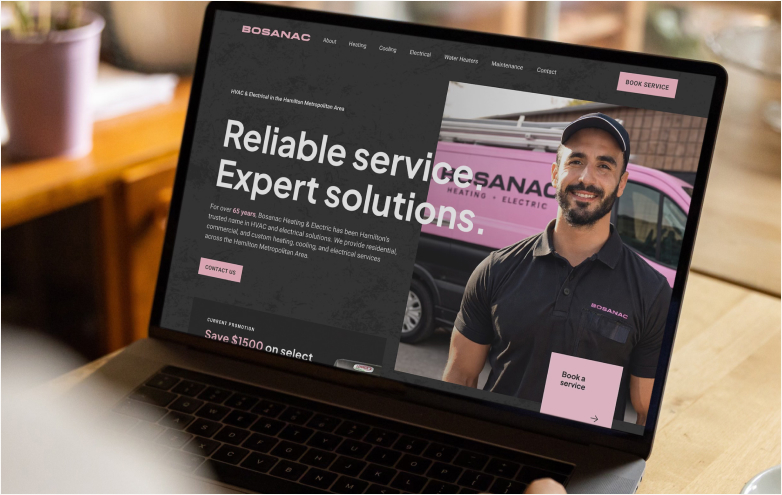
Signs It It’s Time for a Full HVAC Website Redesign
1. Poor Mobile Experience
- Navigation issues: Tiny menus, difficult-to-tap buttons, or hidden service options frustrate users.
- Content misalignment: Text, images, or CTAs that don’t scale for mobile screens create confusion.
- Mobile speed problems: Pages that take several seconds to load on cellular networks reduce engagement dramatically.
2. Slow Load Times
- Large, unoptimised images: High-resolution images without compression or lazy loading can slow pages significantly.
- Bloated code or outdated plugins: Legacy platforms often contain inefficient code that adds unnecessary load.
- Server limitations: Slow hosting can compound technical issues, resulting in a sluggish user experience.
3. SEO Limitations
- Old platforms: Some CMSs or templates lack the flexibility to implement modern SEO best practices.
- Limited structure: Hard-coded pages or non-optimisable URLs prevent proper indexing.
- Missing local targeting: Without optimised meta tags, structured data, or service area pages, your website may fail to reach nearby homeowners actively searching for HVAC services.
4. Outdated UX & Design
- Cluttered layouts: Overcrowded homepages, rotating banners, or excessive text can overwhelm users.
- Weak calls-to-action: Vague buttons like “Learn More” or “Submit” fail to motivate immediate action.
- Poor flow: Visitors may struggle to locate service details, pricing, or contact options.
- Outdated visuals: Fonts, colours, and imagery that look outdated can subconsciously signal unreliability.
5. Security & Compliance Concerns
- SSL certificates: Missing HTTPS can reduce trust and affect search rankings.
- Data protection: Non-compliant forms may put visitor data at risk.
- Plugin vulnerabilities: Old plugins or CMS versions can be exploited by attackers.
Patching vs Full Redesign: Understanding the Difference
Patching
- Updating copy, images, or CTAs
- Fixing isolated issues like broken links
- Temporary speed tweaks
- Minor SEO tweaks
- Short-term visual refresh
Redesign
- Full revamp of structure, design, and backend
- Modernising mobile-first experience, UX, and navigation
- Optimised code, image compression, and hosting improvements
- Full SEO-friendly content hierarchy, meta tags, and local optimisation
- Conversion-focused layouts built around
Canadian homeowner behaviour
If multiple areas—speed, mobile usability, UX, and SEO—are underperforming, repeated patches become inefficient, and a redesign is often more cost-effective and strategic.
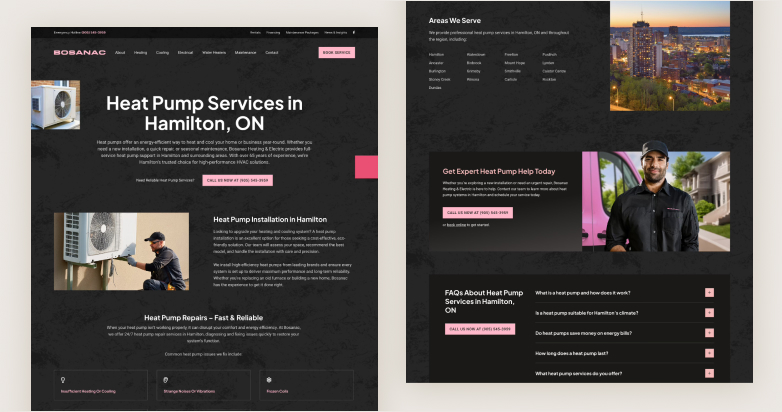
If a redesign is the right move, here’s what a performance-driven build looks like for contractors, HVAC website design
A Detailed Roadmap for a Successful HVAC Website Redesign
1. Website Audit
2. Goal Definition
3. User Journey Mapping
4. Design & Prototype
5. Content Strategy
6. Implementation & Integration
7. Testing
8. Launch & Monitor
How Envy Design Helps HVAC Companies with Redesigns
We help HVAC companies:
- Evaluate existing websites: Identify issues with UX, speed, SEO, mobile performance, and trust signals.
- Plan redesigns strategically: Custom layouts, intuitive navigation, and mobile-first design tailored to Canadian homeowners.
- Implement modern solutions: Optimised coding, fast-loading media, and seamless integration with booking forms, CRMs, and analytics.
- Build trust and credibility: Incorporate reviews, badges, staff bios, before/after galleries, and FAQs into the redesign.
- Monitor and optimise post-launch: Continuous performance tracking ensures your site drives leads and booked services over time.
For HVAC businesses ready to transform their online presence, “Talk to us about an HVAC website redesign.” and see how we can turn your website into a high-converting, modern lead-generation platform.
If you’re still comparing partners, here’s our curated ranking of the Top Web Design Agencies in Canada (2026):
Know When to Rebuild, Not Patch
A comprehensive redesign, executed with a conversion-focused strategy, ensures your website meets Canadian homeowner expectations, maximises leads, improves booked services, and positions your business ahead of competitors.
Partnering with a specialised HVAC Website Design Agency like Envy Design ensures that every redesign is strategically planned, visually modern, technically optimised, and fully integrated with lead-generation tools—turning your website into a powerful business growth engine.